
Summary
Growing coffee is a popular choice as an income-generating project to fund education in rural Africa. We are delighted to have taken the first steps on what we hope will be a long term, locally-managed, project for Uphill.
Grounds for Excitement
As you know, we have always planned to develop local income-generating projects for Uphill Junior School to generate money to pay staff costs and fund ongoing maintenance. After lots of research, a school farm came out as the best option. Local expertise is plentiful in rural areas of Uganda, and agricultural projects offer excellent learning opportunities for children. The preferred crop for the farm? Coffee!

Uganda has recently overtaken Ethiopia as the largest coffee exporter in Africa, and most of this is small holder-grown. The government are actively promoting the production of quality coffee beans, and wholesale prices for both Robusta and Arabica varieties are buoyant.
Last year, Uphill Director Elius had a part-time post with a Ugandan NGO and learned all about coffee production, it’s processing and the ongoing value chain, so we are all very happy with this decision.
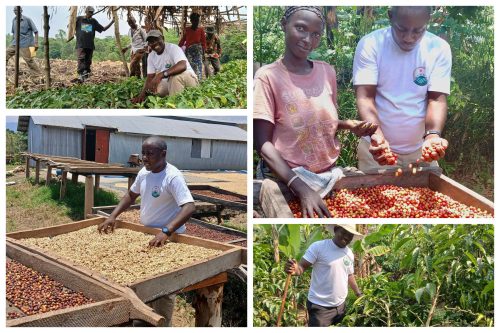
Elius learning best practise in for drying coffee cherries
Whilst researching potential farm sites, we were offered a 4.5 acre plot of farm land, already planted with 2.5 acres of Robusta coffee, in an agricultural area to the south of the school. The price was good and local experts agreed that it would be a sound investment. Thanks to a very generous family donation we were able to negotiate a fair price and the farm transferred into school ownership at the start of May.
Belinda and Max visited the site in October and were taken for a (hot!) walk around the boundaries and learnt more about the plans for maintaining and developing the site.
The farm is on sloping ground, with four main areas. At the top of the site, mature Robusta plants (6 years old) are cropping well, and sequential harvesting will continue over the next 2-3 months. There are two further areas of 3 year old and 1 year old plants, with a wet, open area at the bottom of the slope.
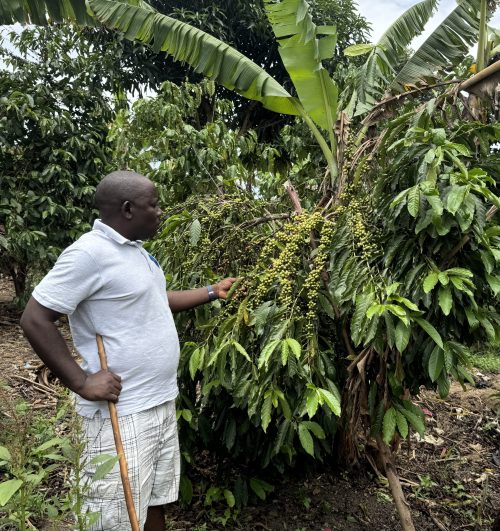
A good crop of cherries developing on a 6 year old Robusta tree
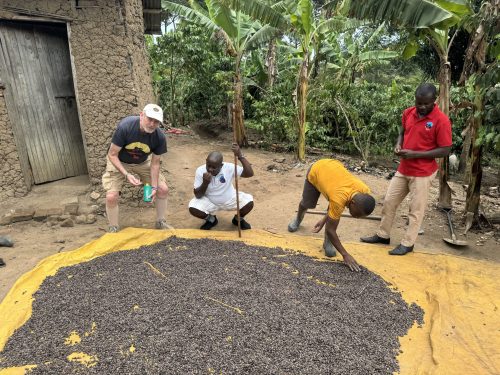
Ripe cherries are harvested and dried in the sun before processing begins
Coffee generally crops twice a year, with the main crop May-August and the smaller ‘fly’ crop in November-February. Harvesting for Robusta coffee is possible when the plants are 3 years old.
Coffee needs moist, but well drained, nutrient rich soil, so targeted applications of fertilizer and irrigation are two important factors we need to consider. Luckily the bottom of the site is swampy – perfect for creating an irrigation pond!
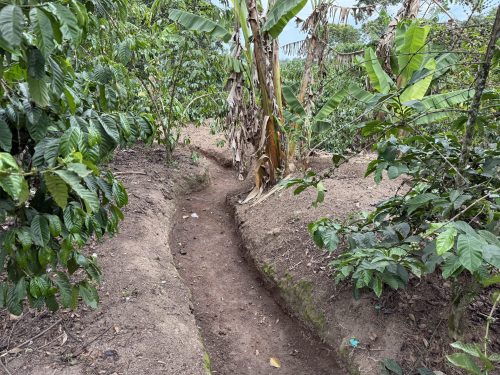
Irrigation channels catch rain water to help keep the soil moist
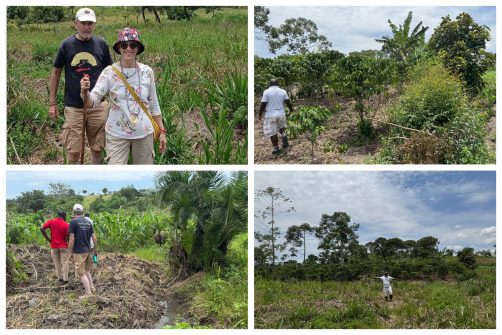
Walking the boundaries and the bottom of the site where the irrigation pond will be
Three funding priorties were agreed during the site visit:
- Providing a secure storage area, along with raised racks for drying the harvested beans. Harvesting will be done by experienced pickers from the local community (mostly women) so it is also important to provide latrine facilities.
- Draining the swampy area to create an irrigation pond. Channels have already been dug to catch water in the rainy seasons but additional moisture will be important in the hot dry seasons (normally two dry and two rainy seasons in a calendar year).
- Coffee theft is a big problem in rural Uganda, so securing the site with barbed wire fencing will be very important. There is already a ‘shamba boy’ who lives on site and patrols regularly, but fencing will make his life much easier!
As time goes on, additional areas of good quality Robusta coffee plants will be established, and other cash crops such as cocoa will be explored. More land will be needed to create the levels of income needed to sustain the school long term, but this can be acquired progressively.
On the way back from the site visit, the trustees enjoyed a visit to a well-established coffee farm and learnt how to prepare the most delicious coffee by hand. Yum!
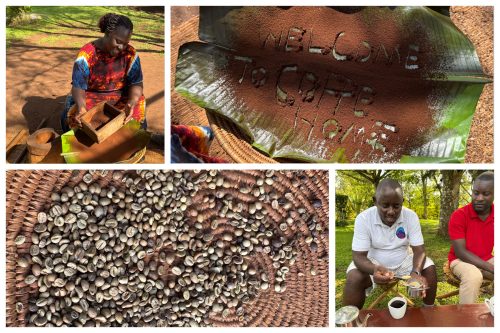
We will continue to report back on the Uphill coffee project – watch this space!

.
Tags: growing valuable cash crops in uganda, income-generating projects, uphill coffee, uphill junior school farm